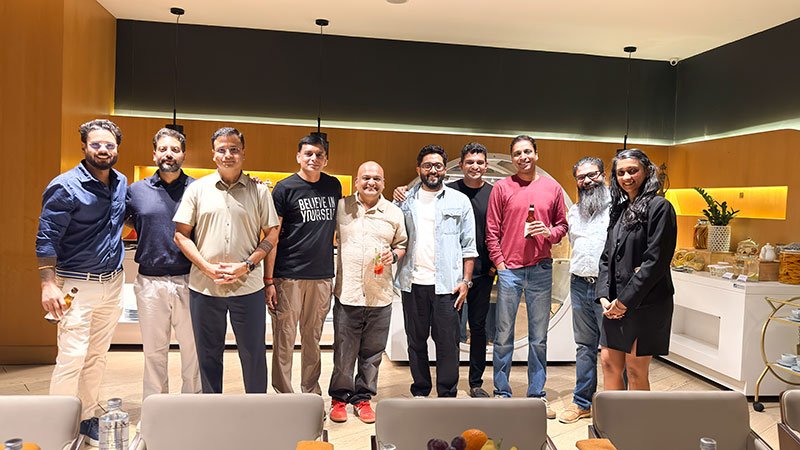
Chatham House Rule applies throughout. Nothing in this document is attributed to a person, company, or brand; by design and by promise made to the room before a word was said.
The Circle of Ten is a closed table; ten senior design, product and business leaders, one evening, no stage. On 11 July 2026, the first table sat for three hours in Bengaluru under a single condition: say anything, attribute nothing. This is what came out of that room, distilled.
This Brief is not a transcript, and it is not a record of who said what. It is a synthesis of the ideas, tensions, and disagreements that surfaced once ten people with real jobs and real pressure stopped performing for an audience and just talked. Every identifying detail; names, employers, exact figures that would point back to one seat at the table; has been removed or generalised, even where that costs the writing some of its punch. That trade was made on purpose. It is the only way a room like this stays honest the second time, too.
What follows are seven findings and one honest account of where the table never agreed. Nothing here should be read as consensus dressed up as fact. Some of it is actively contested inside the group itself; that tension is reported faithfully, not smoothed over for a cleaner narrative.
Ten seats, deliberately mixed. The room held operators running design inside large-scale consumer and retail businesses, leaders inside global enterprise and regulated industries, founders who have built and sold their own studios and companies, an academic voice, and independent practitioners working across categories.
Career lengths ranged from just over a decade to more than four; several had crossed into design from mechanical engineering, construction, copywriting, and the social sciences, not the other way round. Titles were deliberately left at the door; the format asked each person to introduce themselves by what they had actually built and broken, not by what their card says.
The evening ran as an open floor, not a panel. No pitches, no decks, no business cards changed hands. One shared microphone captured the room's own words for exactly this purpose; to build something the table itself would want to read afterwards, without anyone ever being able to point to who said which line.
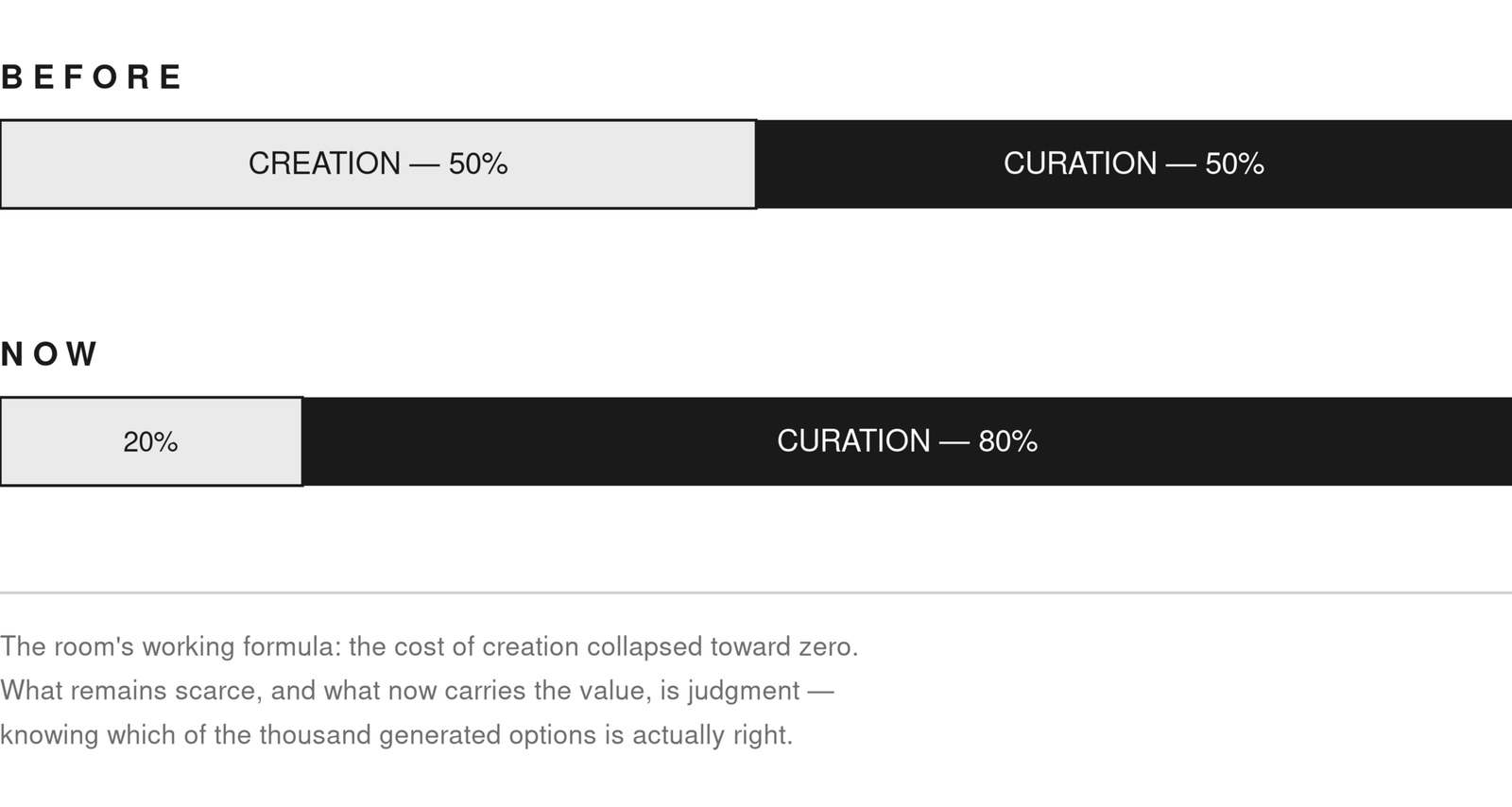
For most of the table's careers, the scarce skill was production; knowing the tool, knowing the format, being able to make the thing. That skill has gone flat. Nearly everyone at the table can now generate a working prototype, a polished screen, a plausible piece of copy, in minutes, with or without formal training. What is scarce has moved downstream: knowing which of the fifty generated options is actually right, and why.
Creation and curation used to split the job roughly fifty-fifty. Today, creation barely counts; the ceiling on how fast you can produce keeps rising regardless of who is doing it. Curation is where the real difference between good and forgettable work now lives, and it is the half of the job that almost no design education or workplace currently trains for.
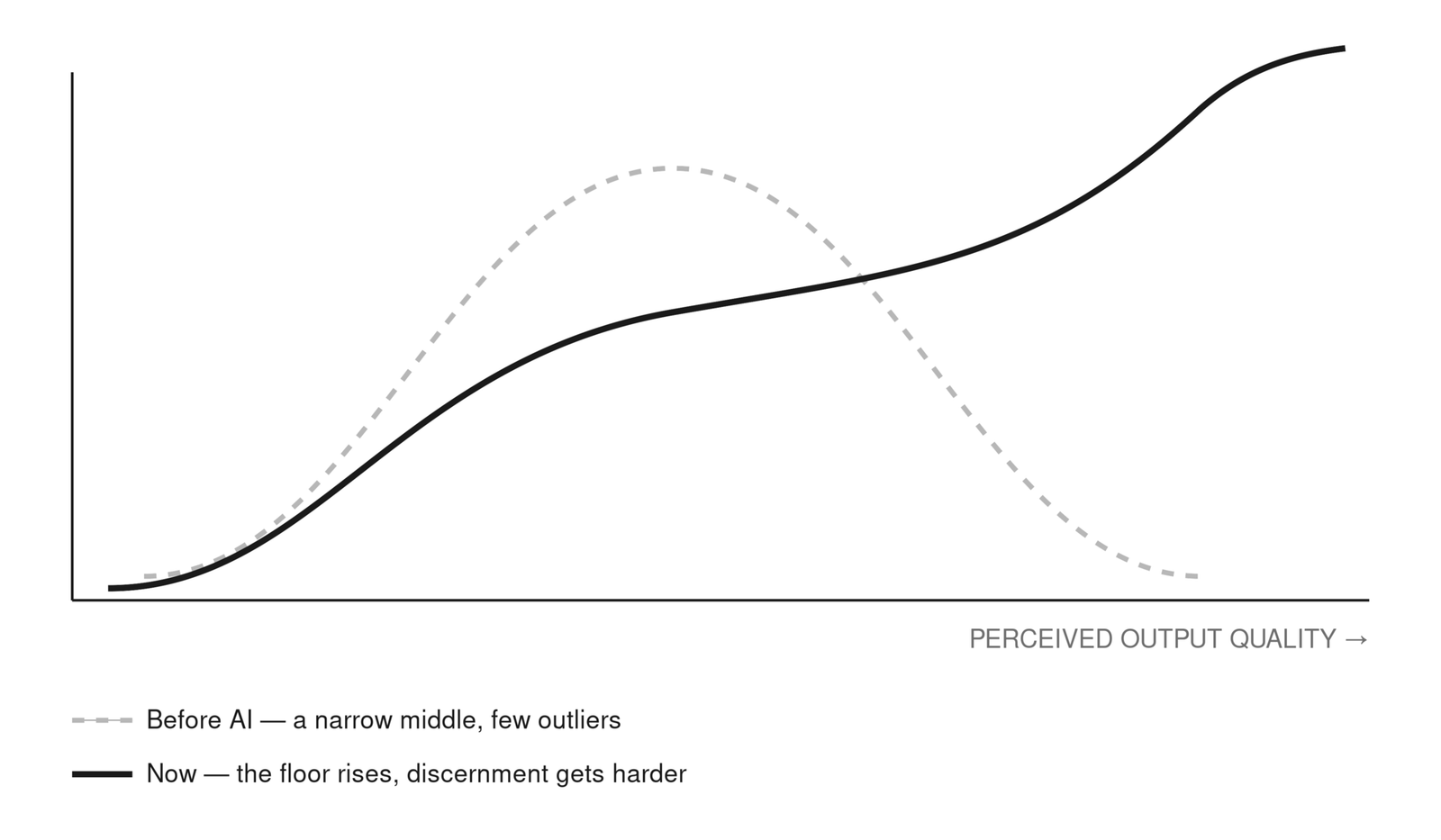
A recurring, near-consensus view: AI does not make weak practitioners strong or strong practitioners weak; it removes the places both used to hide. A strong engineer's code looks better and faster. A weak engineer's gaps, previously buried under time and effort, now surface immediately because review has become the bottleneck, not writing.
The table's read is that the middle of the old bell curve; the broad, average, good-enough layer that used to make up most of any team; is thinning out. Average practitioners are producing better-looking work than they used to. But better-looking is not the same as better, and the number of people who can tell the difference on sight has not grown at anywhere near the rate the volume of plausible-looking output has.
That gap; between what looks finished and what is actually sound; was named directly as the table's biggest emerging risk, not to individual careers, but to product quality at an industry level. Nobody at the table had a clean answer for how organisations catch it before it ships.
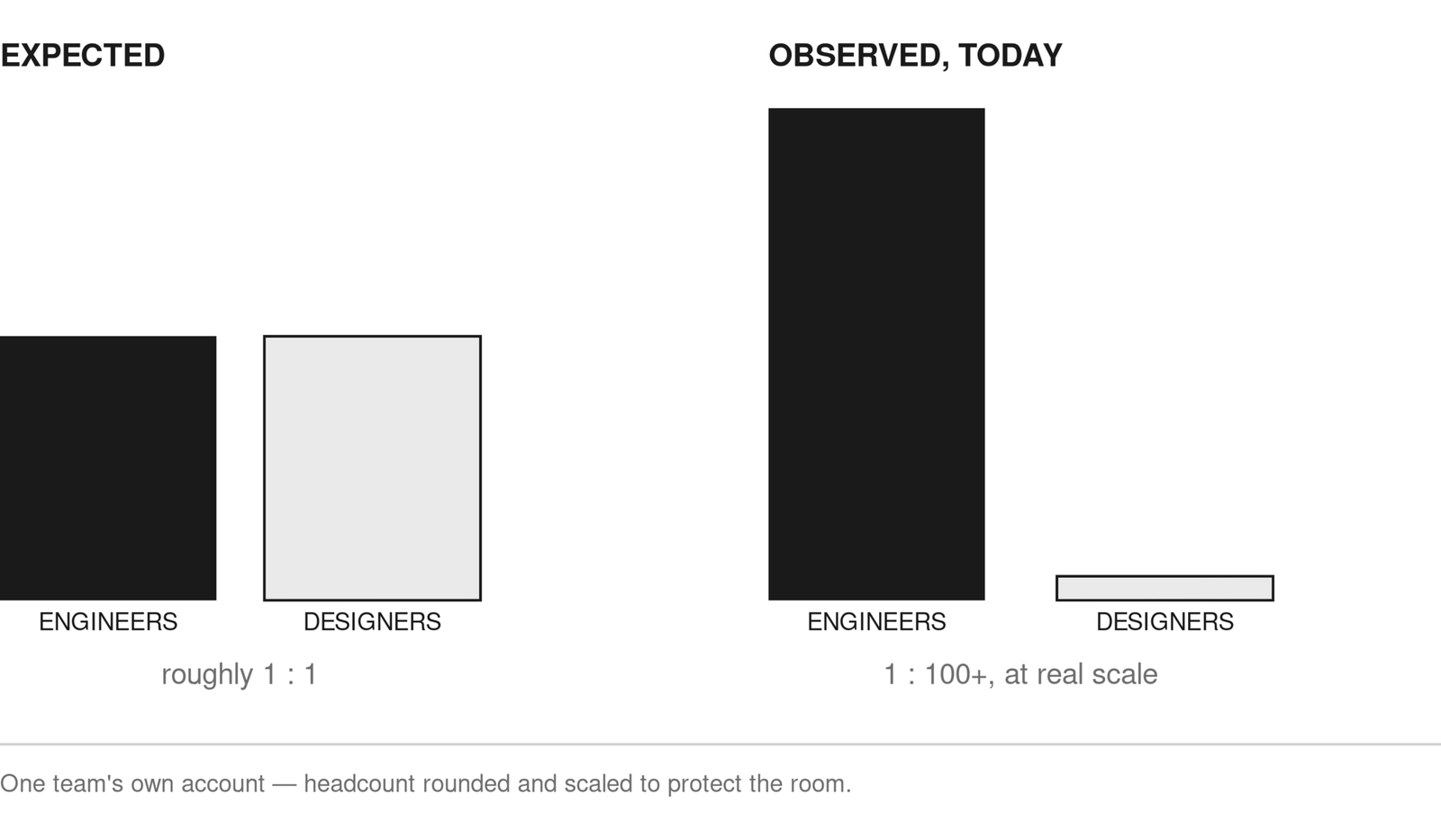
More than one leader described the same structural shift from the inside: design teams are shrinking in headcount relative to engineering, even as the scope of designers' work expands to include product requirements, data analysis, and quality assurance. In one account, designers were raising and shepherding their own pull requests through the engineering review process.
One account from the table: a historical expectation of something close to parity between design and engineering headcount has compressed, in practice, to a low double-digit number of designers supporting an engineering organisation numbering in the thousands.
A related observation landed with particular force: in some cases, AI did not increase engineering productivity so much as relocate the bottleneck. The time that used to go into writing code shifted to reviewing AI-generated code. Throughput stayed flat; the work just moved. That distinction; productivity versus displacement of effort; is a more interesting and less comfortable claim than the headline numbers suggest.
The friction this creates is not subtle. Several at the table described a real and current frustration: as designers pick up more of the product and delivery lifecycle; writing the requirements doc, doing the data work, fixing their own issues instead of filing them for someone else; recognition inside the organisation has not caught up. A small engineering contribution is often celebrated visibly; a much larger, quieter expansion of what design owns tends to go unremarked.
A useful correction surfaced at the table, aimed at a narrative several admitted they had absorbed uncritically: that large, regulated, high-stakes organisations; banking, healthcare, aviation, and large-scale retail infrastructure; are simply slow to adopt AI. The table's counter-argument: when a technology failure carries legal, safety, or balance-sheet consequences, caution is not lagging. It is the correct response to genuinely asymmetric risk.
The historical parallel raised at the table: dominant technology transitions; steam to combustion, older industrial equipment giving way to modern, far more efficient replacements; took years to fully land even after the new technology clearly worked, because trust, regulation, and surrounding infrastructure all had to move together, not just the core capability.
The expectation on the table is that this cycle moves faster than those did, given how much cheaper and more capable the underlying models are becoming, but "faster" was explicitly not read as "fast".
The table pushed past the usual efficiency talk into territory less often discussed at industry events: the actual, uncomfortable cost side of AI adoption. Three costs were named specifically:
Economic: today's AI tools are priced well below what they will eventually cost to run at scale, and that subsidy will not last.
Environmental: the compute and energy footprint behind the convenience is real and growing, even if it is invisible at the point of use.
Social and psychological: transitions that historically unfolded over a generation, giving people and institutions time to adapt, are compressing into a handful of years.
The table split open on where this lands. The utopian position: freed time, fluid identity, a generation growing up without the attachment to productivity-as-identity that shaped everyone at the table. Gen Alpha, in this reading, inherits a world where what you do for a living no longer has to be the centre of who you are. The harder position: a K-shaped economy; a large block at the bottom, a small one at the top, and a redistribution problem nobody in the room had a real answer for. Fewer people employed, buying power eroding even as the cost of goods falls, and the gap between the top of a field and everyone else in it widening rather than closing. Both positions were argued with conviction. Neither carried the room.
A shared concern, raised from multiple angles: junior talent can now produce polished, plausible output without the underlying craft understanding that used to be forced on them by the slowness of doing it by hand. Several at the table described watching this play out in hiring directly; candidates who can generate strong-looking portfolios and prototypes quickly, but who struggle the moment a problem falls outside what the tool has already solved for them.
The countermeasures already in motion at the table were specific and deliberate: structured associate and apprenticeship tracks where new hires are explicitly not held to output targets in their first year, built instead around shadowing senior practitioners and slow, direct skill transfer; the same apprenticeship logic several at the table credited with their own early careers, reintroduced on purpose because the market stopped supplying it by default.
The harder, unresolved question underneath it: is curiosity; the trait the table converged on as the strongest predictor of who thrives in this environment; something that can be taught, or only something you can select for in hiring? The room drew a specific distinction here: curiosity without street-smartness produces people who ask good questions but never reach solutions. The trait that actually predicts survival is not pure intellectual curiosity but curiosity married to pragmatism; the instinct to turn a question into a decision, not just a better question. The table did not settle whether that combination can be taught or only selected for. Most leaned toward "mostly a predisposition, but environment moves it," which is a less comfortable answer than either extreme.
Asked, in effect, what AI structurally cannot cheapen, the table converged fastest and most confidently on one answer: high-touch, in-person, human-delivered experience. The evening's own venue was used, unprompted, as the live example; the kind of attentive, deliberate service that a machine can approximate but has not yet replaced at the price point where people still choose to pay a premium for it.
A more personal version of the same idea surfaced repeatedly through the evening: several at the table are already redirecting the time AI has freed up toward things it cannot do for them; finishing a book that would never have gotten written otherwise, learning a craft properly, teaching, building something small and deliberately unscalable whose only goal is helping a handful of people find meaning rather than growing a user base.
Three open disagreements are worth naming honestly rather than resolving artificially for the sake of a tidier brief.
One camp argued that the future belongs to a broad practitioner who pairs domain depth with fluency across adjacent disciplines and tools. The other argued the opposite: pick one domain, go deep, and use AI as leverage inside that depth rather than spreading across many. Both camps had senior, credible voices behind them. Neither yielded.
Does freed-up time and falling cost of production net out to more human flourishing, or to fewer paid seats and a widening gap between the people at the top of a field and everyone else in it?
The table agreed that curiosity is the strongest predictor of who thrives, but split on whether it can be cultivated or only selected for. The complication: curiosity alone is not enough. Without the street-smartness to turn questions into solutions, it produces articulate people who never ship. Nature versus environment, with real consequences for how the table's own organisations hire, train, and promote next.
None of these was put to a vote. They are presented here as the table left them: live, unresolved, and worth returning to at the next one.
Nothing here would have surfaced with a stage, a panel format, or a single company's name attached to a single opinion. What made three hours of genuinely candid conversation possible was structural, not personal: one shared microphone instead of an audience, a hard rule that nothing leaves the room attributed, and a requirement that everyone at the table speak; there is no observer seat.
Ten strangers walked in performing nothing, and left having built enough trust to start a private conversation that is still running.
A synthesis prepared and written by Mayur Chaudhary, founder of RethinkingUX. Not a verbatim record; no line in this document should be read as a direct quotation attributable to a specific person.