The Circle Paper / October 2026

The Leadership Reset.

What must we unlearn about teams, talent and influence?
And what should we protect?

17 October 2026BengaluruA closed-door conversation
Enter the conversation ↓
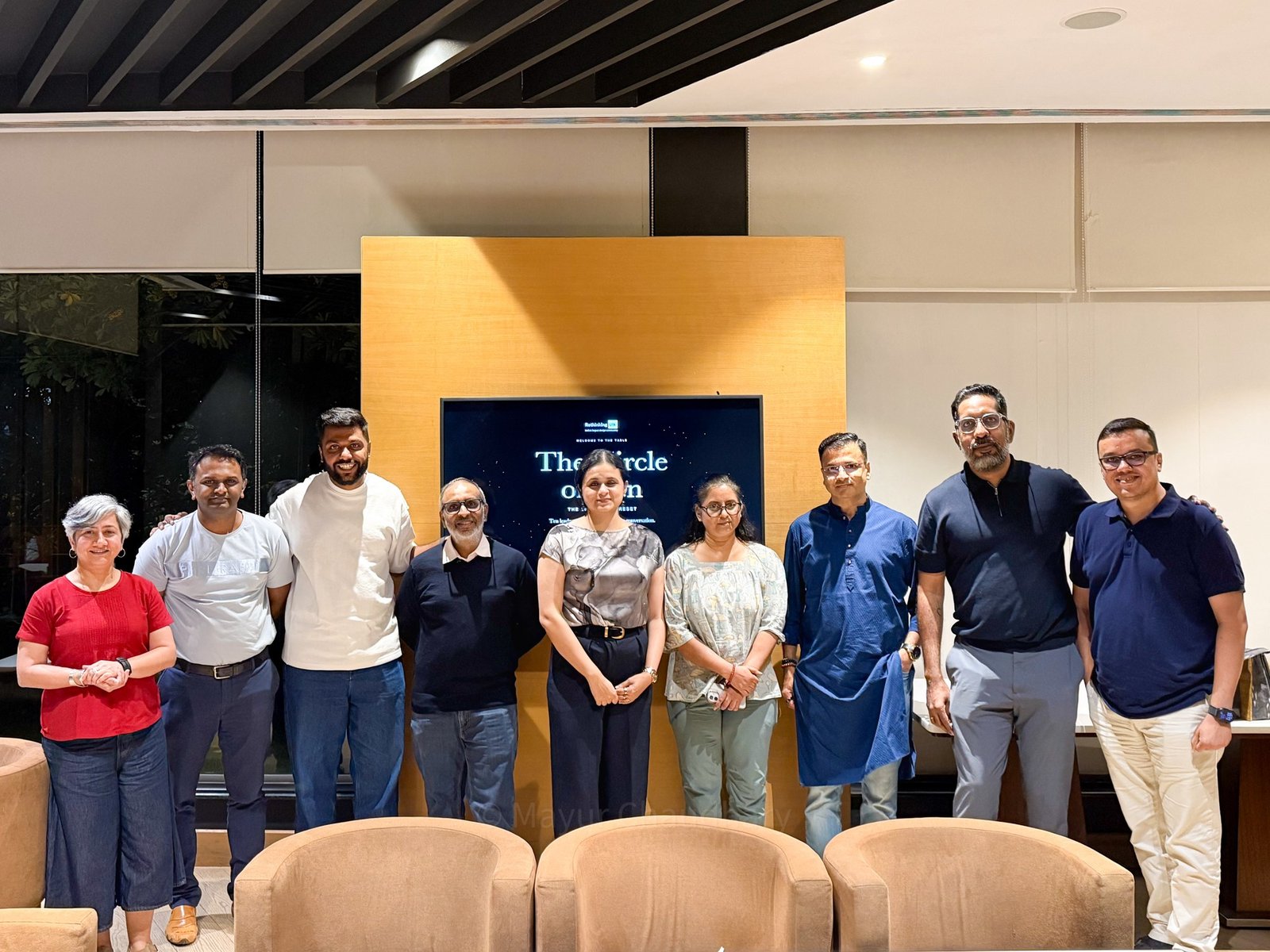
The group gathered for The Leadership Reset

A note from the table

The tools changed.
The hard questions stayed.

The most useful conversation was not about which AI tool to use. It was about what leaders are becoming while they use them.

Across the evening, excitement about making sat alongside frustration, uncertainty and a desire to stay human. Faster prototypes opened new possibilities. They also amplified older problems: weak problem framing, unclear responsibility, uneven support for people and the temptation to confuse visible work with valuable work.

Prepared and reviewed by Mayur Chaudhary, founder of RethinkingUX and host of The Circle of Ten, this paper brings the evening’s most important ideas to the wider community. It holds space for different views, practical lessons and questions still worth exploring, while keeping every contribution unattributed.

Your reading route

Eight tensions.
One leadership reset.

Read in sequence, or start with the question closest to your work.

  1. 01 Craft
  2. 02 Foundations
  3. 03 Systems
  4. 04 Economics
  5. 05 Leadership
  6. 06 Humanity
  7. 07 Influence
  8. 08 Learning

The central tension

More output does not
automatically mean more value.

Becoming easier

Generating
Prototyping
Producing

Still needs deliberate work

Understanding
Choosing
Taking responsibility

A conceptual synthesis of the discussion, not a measured comparison.

01 / Craft

When everyone can make, judgment becomes the work.

AI has widened access to making. A convincing interface, prototype or presentation can now appear before the underlying problem is understood. At the table, that was both an invitation and a source of unease: the ability to produce something is increasingly mistaken for the ability to design it well.

The distinction leaders returned to was judgment. Who is this for? What makes this direction right? What has been left out? A polished output cannot answer those questions on its own. Experience matters when it helps someone recognise consequences, not simply when it confers seniority.

There was optimism about building directly and experimenting more freely. There was also frustration with work that looked finished but had not been thought through. The opportunity is to shorten the distance between an idea and a test, without shortening the thinking that makes the test useful.

Take this into your next week

Ask for the reasoning behind an output, the alternatives considered and the evidence that would change the decision.

02 / Foundations

Protect the practice that builds taste.

When a tool can complete a task immediately, the unfinished stage can start to feel like failure. But sketching, trying alternatives, observing people and struggling with a problem are also how designers build discernment.

Leaders described pausing before prompting, writing ideas down independently and making space for exploration that does not need to become a deliverable. A more restrictive suggestion was to delay access to AI for people still learning the foundations. That remained a proposal, not an agreed approach.

The unresolved question is how to teach judgment without making people rehearse yesterday’s workflow. A deliberate pause can deepen a decision. A blanket ban can also prevent learning. Teams need to explain what a learning exercise is protecting, not simply ask people to slow down.

Take this into your next week

In a critique, ask what the designer noticed, what they rejected and what they learned. Evaluate understanding alongside execution.

“There are a lot of human things that we have in our control, but we choose to outsource.”
03 / Systems

The interface is only one layer of the system.

Systems thinking connected several strands of the conversation: placing someone on the right project, enabling their growth, understanding a customer’s constraints and anticipating the effect of a product decision elsewhere.

Leaders worried that a working front end can hide a fragile system. Shipping code brings responsibilities beyond the visible screen: dependencies, data access, testing, security, observability and recovery. These are not reasons to exclude designers from code. They are reasons to make ownership and review explicit.

The same principle applies inside a team. Optimising one function in isolation can move the burden to another. Faster generation can leave engineering with more to review, or push basic questions about users and success to the final deployment stage.

Take this into your next week

Before calling a prototype production-ready, identify who reviews it, how success is measured and how a failed release is reversed.

An interface is not the whole product

The visible experience What people see and use
Behaviour & business logic What the product does
Data, permissions & dependencies What makes it possible
Security, monitoring & recovery What makes it trustworthy
Illustrative layers, not a prescribed software architecture. Ownership has to connect the whole system.
04 / Economics

Design for the customer’s constraints, not your own access.

The table described very different conditions for experimentation. Some environments provide extensive AI access; others allow only a narrow set of approved capabilities. Neither experience is a reliable proxy for what customers can afford or use.

Usage-based costs can turn a delightful workflow into an expensive habit. Leaders raised a practical risk: a team with generous access may design a product whose economics make little sense for the people buying it.

There was a counterview, too. As capability improves and costs change, today’s token constraints may become less visible. The disagreement matters. Design should account for present costs while avoiding the assumption that today’s pricing is permanent.

Take this into your next week

Explore repeated use, not just a single successful demo. Make cost, latency and recovery visible during evaluation.

Explore the trade-off

A cheap action can become an expensive workflow.

Efficient workflow
20 units
Retry-heavy workflow
60 units

Illustrative model only: 1 versus 3 abstract cost units per action. No prices, usage data or results from the event are represented. The relationship shown is deliberately simple.

05 / Leadership

A flatter team still needs a place to grow.

Leaders described the tension between being closer to the work and being pulled into every decision. Flatter structures can reduce distance, but they can also consume the time needed for strategy, coaching and cross-functional relationships.

Expectations were moving faster than the time available to develop people. The conversation did not resolve how a leader can support everyone equally under pressure. It did make that limit visible.

There was a strong thread of investing in people beyond their immediate usefulness to an employer. Alongside it sat a harder question: what can a leader honestly promise when organisational decisions are outside their control? Care requires candour about those limits, rather than reassurance that cannot be kept.

Take this into your next week

Make growth support concrete: clear decision rights, a realistic next responsibility and time to learn with feedback.

06 / Humanity

Boundaries are something leaders demonstrate.

The discussion moved beyond tools into identity, exhaustion and the difficulty of separating commitment from constant availability. A leader can value their work deeply and still need a life outside it.

Leaders spoke about making expectations explicit, distinguishing an emergency from an internal habit and using scheduled messages instead of triggering weekend notifications. These were ordinary behaviours with cultural consequences.

The point was not that every role can follow the same hours. It was that unspoken expectations travel down a hierarchy. When leaders protect time themselves, others have more permission to do the same. More automated output should not quietly become a demand for more human availability.

Take this into your next week

Agree what counts as urgent. Say when a response is expected. Model the boundaries you want the team to believe.

A question to keep

What does your own availability teach the team to expect of itself?

07 / Influence

Move upstream, before the brief becomes the answer.

If design’s value is defined entirely by producing the final artefact, easier production puts that value under pressure. Leaders discussed moving earlier into the work: identifying the right problem, framing options and connecting experience decisions to business outcomes.

This is not an argument for abandoning craft. It is an argument for giving craft a better problem to solve. A large quantity of generated research or pitch material has little value if someone still needs to turn it into a relevant decision.

The table questioned reliance on cost advantage alone. The more durable distinction was framed around impact, specialist knowledge and the ability to understand a system. None of these guarantees job security. They do provide a more useful direction for development than competing on output volume.

Take this into your next week

Write the decision a piece of work needs to enable before generating the material that supports it.

Where design can contribute

01FrameFind the right problem
02ExploreMake choices explicit
03DeliverBuild, test and learn
An editorial model based on the discussion. These activities overlap and feed back into one another; they are not percentages of a designer’s job.
08 / Learning

Curiosity needs room for disagreement.

AI adoption did not fall neatly along age or seniority lines. Leaders described enthusiasm, scepticism and uneven confidence across experience levels. The conversation challenged its own assumptions about who is willing to learn.

Questions from less experienced people can reveal expectations that have become invisible to leaders. Asking why a tool is necessary, what a new responsibility means or how someone will be supported is not automatically resistance.

The table also recognised the limits of a room made up of experienced leaders. Future conversations would benefit from more career stages and more varied perspectives. Learning across generations should involve listening in both directions.

Take this into your next week

Invite the question you find inconvenient. Explain the purpose of a change and let the people affected help evaluate it.

Other threads worth carrying forward

The reset reaches beyond
the design workflow.

Agent access is a trust decision.

Leaders raised concerns about connecting agents to accounts and information. The useful principle is broader than any particular tool: access needs boundaries, actions need a trace, and someone needs the ability to intervene. Convenience does not remove responsibility for what an agent can do.

Keep knowledge portable and useful.

The conversation explored keeping working knowledge in portable formats so it can move between tools. It also questioned the value of producing large amounts of material without processing it into an answer. Useful memory is organised context that someone else can understand, not merely an archive of outputs.

Coordinate experiments before building another tool.

Easy creation can produce parallel solutions to the same internal problem. A shared inventory, a named owner and a clear user need can make experimentation more useful. The point is not to stop people making; it is to help a promising experiment become something others can maintain and use.

Protect a professional identity wider than a job title.

Leaders reflected on the uncertainty of work and the value of interests, learning and relationships beyond a single role. The community takeaway is to keep those connections alive before they become urgent.

Keep human contact inside the learning loop.

Hands-on, small-group exercises were discussed as one way to move from execution toward consulting and problem framing. The larger point was to retain direct contact with people: empathy, accessibility and understanding cannot be reduced to how convincingly a tool describes them.

The questions left open

A useful table does not
need a unanimous answer.

01 / Learning

Protect foundations.
Or learn through the new tools?

Deliberate practice mattered to the room. Restricting AI access was one proposed route, not a settled prescription. What evidence would tell a team that someone is developing judgment?

02 / Ownership

Let designers ship.
But who carries the risk?

Direct control can preserve craft. It also expands the responsibility for code quality and reliability. The answer requires shared review standards, not a territorial boundary.

03 / Economics

Design for today’s costs.
Stay open to tomorrow’s change.

Usage economics deserve attention now. Falling costs may change the equation. Neither a free internal allowance nor an assumed future price should substitute for a customer test.

Looking ahead

The future is a set of
questions to work on.

Two lenses: what the table anticipated, and what this paper’s editorial synthesis suggests watching. Neither is a prediction of a certain outcome.

From the conversation

What leaders expected

  • More overlap between making roles. Design, product and engineering work may become less neatly separated.
  • More review and orchestration. Producing work faster may shift attention toward evaluating, integrating and governing it.
  • More pressure to show value. Tool access alone is unlikely to explain why a team’s work matters.
  • Changing economics. Usage costs may become less conspicuous as capability changes, while still shaping present decisions.
  • A continuing need to adapt. Leaders offered uncertainty and experimentation rather than one stable career map.
Editorial perspective

What the community should watch

  • Decision quality. Does a shorter cycle produce better outcomes, or simply more things to evaluate?
  • The new review bottleneck. Track whether generation saves time overall or moves effort into checking and repair.
  • Learning with evidence. Ask people to explain choices and revisit them after real-world feedback.
  • Accountability across layers. Establish ownership for data, cost and recovery before opening the production gate.
  • The human cost of speed. Look for healthier workloads and clearer boundaries alongside efficiency gains.

Watch for signals, not deadlines. These are directions for inquiry, not a forecast chart.

A field guide for the community

Less to perform.
More to practise.

Six small changes that turn the conversation into work you can examine.

  1. 01

    Write the problem before the prompt.

    Name the person, the need and the decision you are trying to enable.

  2. 02

    Make the reasoning reviewable.

    Show alternatives and trade-offs alongside the finished artefact.

  3. 03

    Review the system, not just the screen.

    Include data, access, cost, testing and recovery in the conversation.

  4. 04

    Make room to learn.

    Protect deliberate practice; judge its effect by understanding, not ritual.

  5. 05

    Model one meaningful boundary.

    Clarify urgency, response expectations and time that is genuinely protected.

  6. 06

    Bring in a perspective missing from the room.

    Invite people at another career stage to question an assumption you have stopped noticing.

Keep the conversation open

Three questions.
No polished answers required.

  1. What do you feel you’re expected to have figured out as a leader, but are still figuring out?
  2. When did you last change your mind because someone on your team challenged you?
  3. What are you holding on to as a leader that you may need to let go of?
“We have to evolve, we have to adapt.”From the conversation
An empty table and chairs set for a future conversation

The conversation continues

There is more
to put on the table.

A small room. Different perspectives. Enough trust to ask the question you usually keep to yourself.

If this paper raised something you want to explore with other leaders, express interest in a future gathering.

Join the waitlist

An expression of interest, not a confirmed seat.